
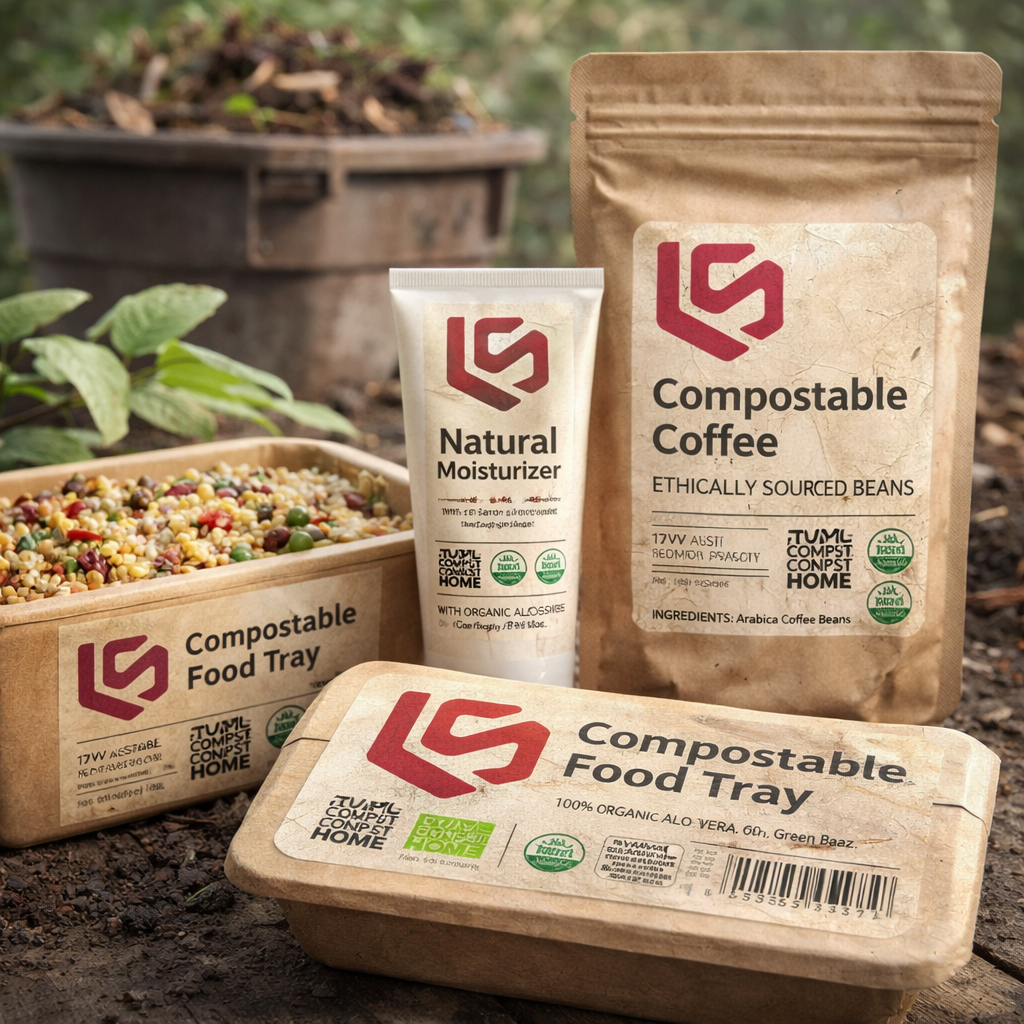
As compostable packaging becomes more common across food, cosmetic and environmental product categories, scrutiny is shifting to every component of the pack. It is no longer sufficient for the container alone to meet compostability standards. Labels, inks and adhesives are now part of the compliance conversation.
In 2026, brands promoting compostable packaging must ensure their labels align fully with recognised compostability criteria. Anything less risks undermining certification claims and confusing disposal pathways.
Why Labels Are Under Greater Scrutiny
Industrial composting standards assess whether packaging components break down within defined timeframes under controlled conditions. Materials must disintegrate, biodegrade and avoid leaving harmful residues.
A compostable tray or pouch fitted with a conventional plastic label creates a contradiction. If the label fails to decompose at the same rate as the primary packaging, it may need to be removed before disposal. That instruction complicates consumer behaviour and increases the risk of contamination in organic waste streams.
Regulators and certification bodies are increasingly clear: all components entering the compost stream must be compatible with it.
Material Compatibility and Performance
Biodegradable labels are typically produced using bio-based or compostable films designed to break down in industrial composting conditions. However, substrate selection is only one part of the equation.
Adhesives play a critical role. Standard permanent adhesives are engineered for durability and resistance, not disintegration. If the adhesive remains intact while the label face stock degrades, compost quality may be affected.
Compostable adhesive systems are therefore required to ensure the entire label construction behaves consistently during decomposition. These adhesives must provide sufficient bond strength during the product’s usable life, yet allow breakdown under composting conditions.
Balancing durability during use with biodegradability after disposal is a technical challenge, but modern material systems are designed to achieve both.
Maintaining Print Integrity Without Compromising Sustainability
Sustainable packaging must still function in real-world retail and distribution environments. Labels must withstand handling, moisture exposure and temperature changes long enough to communicate essential information.
Biodegradable labels can be printed using inks compatible with composting systems. Print quality remains sharp and legible while ensuring that no harmful residues remain after processing.
The objective is full lifecycle alignment. During the product’s life, the label must perform like any other high-quality label. After disposal, it must decompose alongside the pack without creating contamination.
Avoiding Greenwashing Risks
Sustainability claims attract increasing scrutiny from regulators and consumers. If a brand markets packaging as compostable but relies on non-compostable labels, the inconsistency may raise compliance questions.
Clear disposal instructions are also critical. If consumers are unsure whether to remove the label before composting, contamination rates may increase. This can affect waste processing efficiency and undermine environmental claims.
Using fully compostable label constructions simplifies communication and strengthens the credibility of sustainability messaging.
When Biodegradable Labels Become Essential
Biodegradable labels are particularly appropriate when the primary packaging is certified compostable and intended for industrial composting streams. They are also advisable when compostability claims form a core part of brand positioning.
Products entering organic waste systems, food service environments or closed-loop composting schemes benefit from consistent material alignment. In these contexts, partial compliance is not enough.