
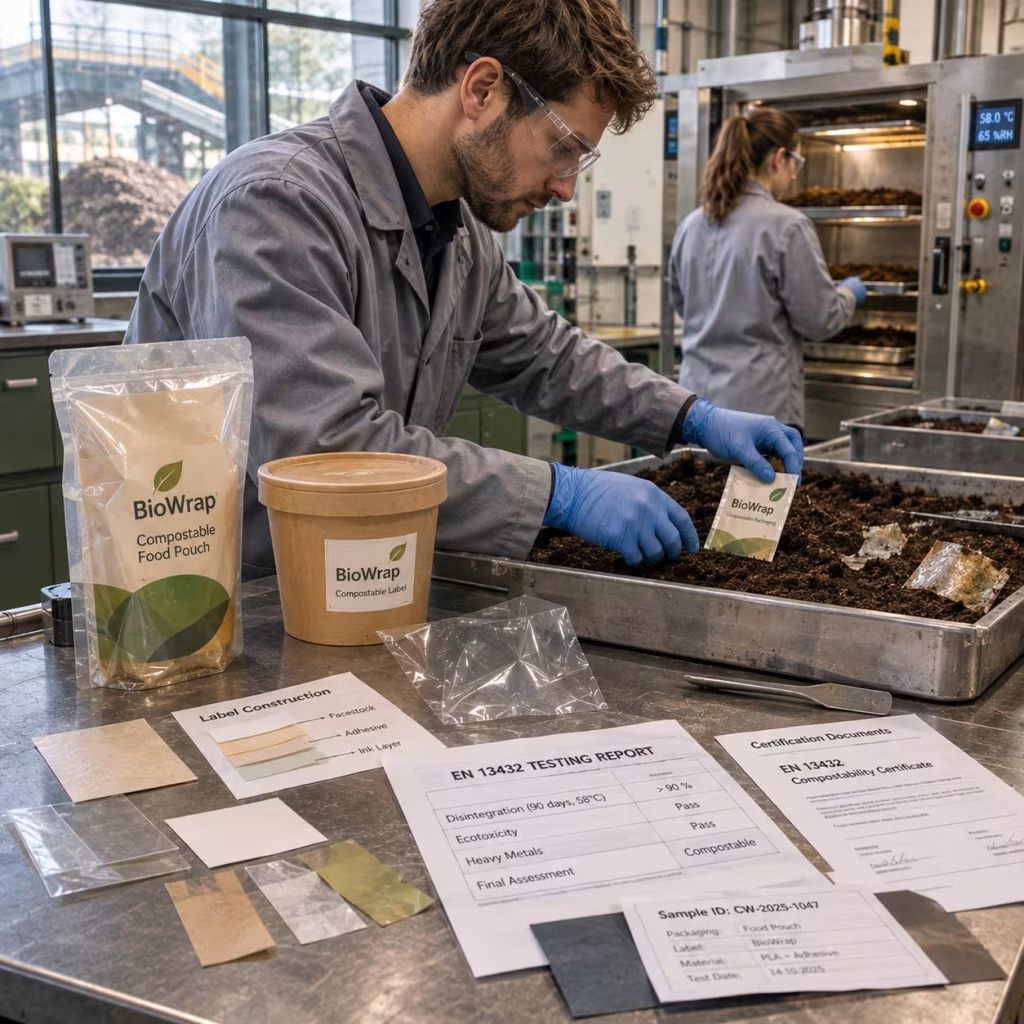
“Compostable” is one of the most valuable words a brand can print on packaging, and one of the most frequently misunderstood. In the UK and Europe, the benchmark for industrially compostable packaging is EN 13432, and it sets a far higher bar than many assume.
In this article, we explain what EN 13432 requires, why every part of a label must meet it, and how the standard differs from home compostable claims.
What Does EN 13432 Require?
EN 13432 is the European standard that defines the requirements for packaging to be recovered through industrial composting. To meet it, packaging must pass four main tests.
The first is biodegradation. At least 90% of the material must be converted to carbon dioxide within six months under controlled composting conditions. The second is disintegration. After 12 weeks, no more than 10% of the material may remain on a 2mm sieve. The third is chemical composition, with strict limits on heavy metals and other substances. The fourth is compost quality, meaning the finished compost must not harm plant growth.
All four must be met. A material that breaks down quickly but leaves contaminants behind does not qualify.
Does Every Part of the Label Need to Comply?
Yes. A compostable label is only compostable if every component is. That includes the facestock, the adhesive and the inks, as well as any varnish or coating. A paper label with a conventional adhesive, or a compostable film printed with unsuitable inks, may not meet the standard as a whole.
Thickness matters as well. Compostability certification is usually granted up to a maximum tested thickness, so a heavier facestock or a thicker construction may fall outside the certificate even when the same materials are used.
This is why certification matters. Independent schemes test finished materials against EN 13432 and allow certified products to carry recognised compostability marks. Brands should ask their label supplier for certification covering the complete label construction, not just the face material, and keep that evidence on file in case a retailer or regulator asks to see it.
Is Industrial Compostable the Same as Home Compostable?
No. EN 13432 is based on industrial composting, where temperatures are significantly higher than in a garden compost heap. Home compostable certification uses separate, lower temperature testing over a longer period. A label certified only to EN 13432 should not be described as home compostable.
Collection is the other practical limit. Industrially compostable packaging only composts if it reaches an industrial composting facility, and many UK councils do not accept compostable packaging in household food waste collections. A certified label is still only as useful as the route it takes after use.
That distinction is becoming more important. The EU Packaging and Packaging Waste Regulation will require sticky labels on fruit and vegetables to be compostable from February 2028, and claims on pack are under growing scrutiny from regulators.
In the UK, the Competition and Markets Authority can now fine businesses directly for misleading environmental claims, which makes vague or overstated compostability wording a real commercial risk.
Compostable labels can be a genuine environmental improvement. They are most credible when the claim on pack matches exactly what has been certified, and nothing more.